


Applied astrobiology
Earth is the jewel of our solar system, and, as far as we know, our Galaxy—the only world with sunlit oceans, cities, song, forests, spacefarers, and a habitable climate underpinning it all. We know how the natural greenhouse effect keeps Earth warm. Without it, Earth would be frozen.
We do not know why one planet’s climate sustains life while the others do not. The physics of climate are very permissive. Tiny quantities of haze can cool down too-warm worlds, and tiny amounts of greenhouse agents can warm too-cold worlds. The solar system as a whole is rich in life-essential volatiles like nitrogen and water, and the quantity of volatiles needed for an atmosphere is small on a cosmic scale (Earth’s atmosphere, for instance, is a part per million of Earth’s mass).
But the birth and youth of planets offer many opportunities for things to go wrong (from the point of view of beings who value forests, cities, song, and so on).
Life-essential volatiles tend to congeal where it is too cold for life, far from the star. The few volatiles that manage to reach the inner worlds can be ejected by impacts, ablated by stellar wind, or shed to space. Just the right amount of volatiles are needed: too many will at first shut down geochemical cycles and next magma-fy the surface.
If the planet happens to freeze up, the sunlight bounced back to space can keep it frozen. Earth had four near misses.
The rocks must cooperate: in our Solar System, Earth is the only planet with both plate tectonics and life. This is probably not a coincidence. Mars and Venus both show that—given the raw material to create and sustain a habitable environment—Nature does not usually take that chance. What little we know about rocky exoplanets is consistent with this idea (most that have been scanned are bare rocks, without atmospheres1). Some have taken this history to mean that life is extraordinarily rare in our universe.2 Whether or not this is true, the great majority of worlds that could have life, don’t.
So while the physics is permissive, chance has left worlds other than Earth without sunlit oceans, song, forests, or a habitable climate.
Until very recently, humans could do nothing about this. For the first three-quarters of our species’ history, none of us even left our birth continent. (For 90% of our history, people only occupied Earth’s Eastern hemisphere). We used to have our eyes to the ground. Now we look up. Space travel has become an international endeavour. In a century (a plausible length for the life of a child born today), we have gone from horse carriages to Voyager 2.
As a result of investment fueled by the curiosity, greed, fear and pride that drive us into space, we now have inexpensive access to that space. A coast-to-coast drive for a family of four costs $10/kg of payload: it’s plausible that the costs to Earth orbit in five years will be $40/kg of payload. Once you make it to Earth orbit, you are energy-wise halfway to anywhere in the Solar System.
Despite our achievements in getting to space (flying inside the rings of Saturn, for example) and in science more broadly (decoding our own genes, controlling nuclear fusion, or doubling our lifespans, for example) we still have a long way to go in the domain of making other planets habitable. A lot of humility is therefore still in order. For the foreseeable future, the quantity of volatiles needed for a habitable world (while minute on a cosmic scale) will exceed our transport abilities.
We can therefore narrow our search for world-scale transformation opportunities to places where the materials needed for life are already there. So we need places that already have both water, in the form of ice, and plenty of sunlight. Both are needed to fuel a photosynthetic biosphere. The overlap zone between places with both water (which is mostly in the outer solar system) and sunlight (which is strongest closer in) includes Mars, the outer asteroid belt, and (optimistically) the Moon. Of these candidates, only Mars has an atmosphere, so it seems like a logical place to start.
Mars: the backstory
While Mars still has the basic ingredients needed for life (including >1016 W of sunlight energy that could fuel the photosynthetic base of an ecosystem), its surface poses many—individually severe and collectively forbidding—challenges to life. The first and most basic is that there is no liquid water anywhere: the ice never melts. Mars used to have rivers and seas, but they dried up and froze over billions of years ago.
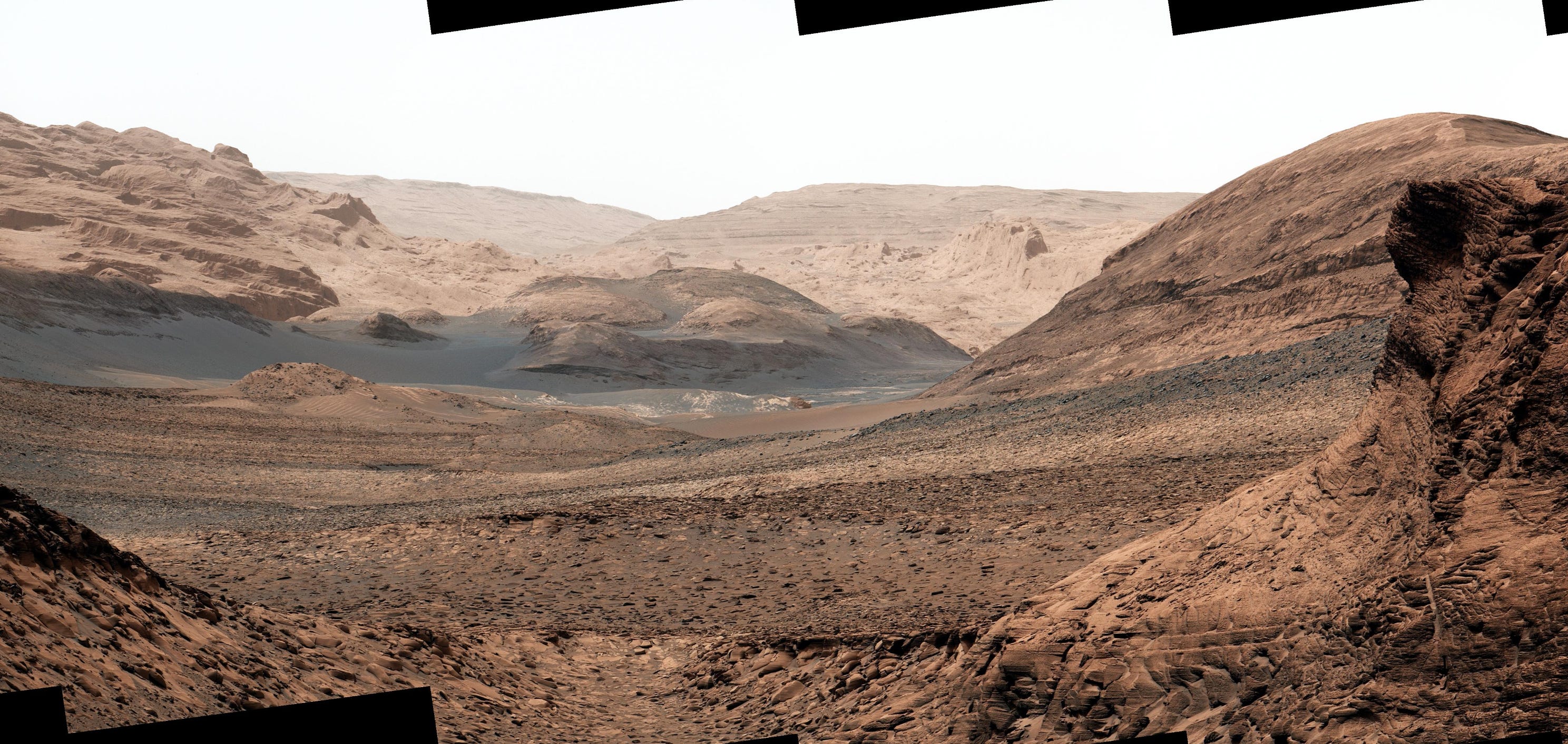
Ever since NASA first studied terraforming Mars in the mid-1970s3, it has been broadly understood that we can’t use terrestrial biology to bootstrap our way out of this. We can’t use the metabolic products of microbes to make Mars habitable, because no terrestrial organism can grow on Mars’ surface today.
The alternative pathway those first studies introduced is a two step process: first warm Mars up, then use photosynthesis to build up atmospheric oxygen.
Careful calculations that began in the 1990s showed that warming Mars with greenhouse gases would require 1014 kg of gas, using an element (fluorine) that is very rare on Mars. This would need energy (to make the gas from those hard-to-get materials) at a scale comparable to humanity’s total energy use today. There was no plausible way to reach those targets, certainly not with pre-2020 rockets. The research field hit a logjam, about six orders of magnitude shy from taking the first step.
Then, around 2020, several teams found new approaches that looked promising4. Translucent, insulating sheets could melt the ice. Or solar sails could fly themselves from Earth orbit to Mars, then bounce sunlight down to the surface. Or engineered aerosols could warm the planet four orders of magnitude more mass-efficiently than gases, using materials readily available on Mars.5 As Mars has thin air and no ocean, it would warm within months once a warming system is in place.
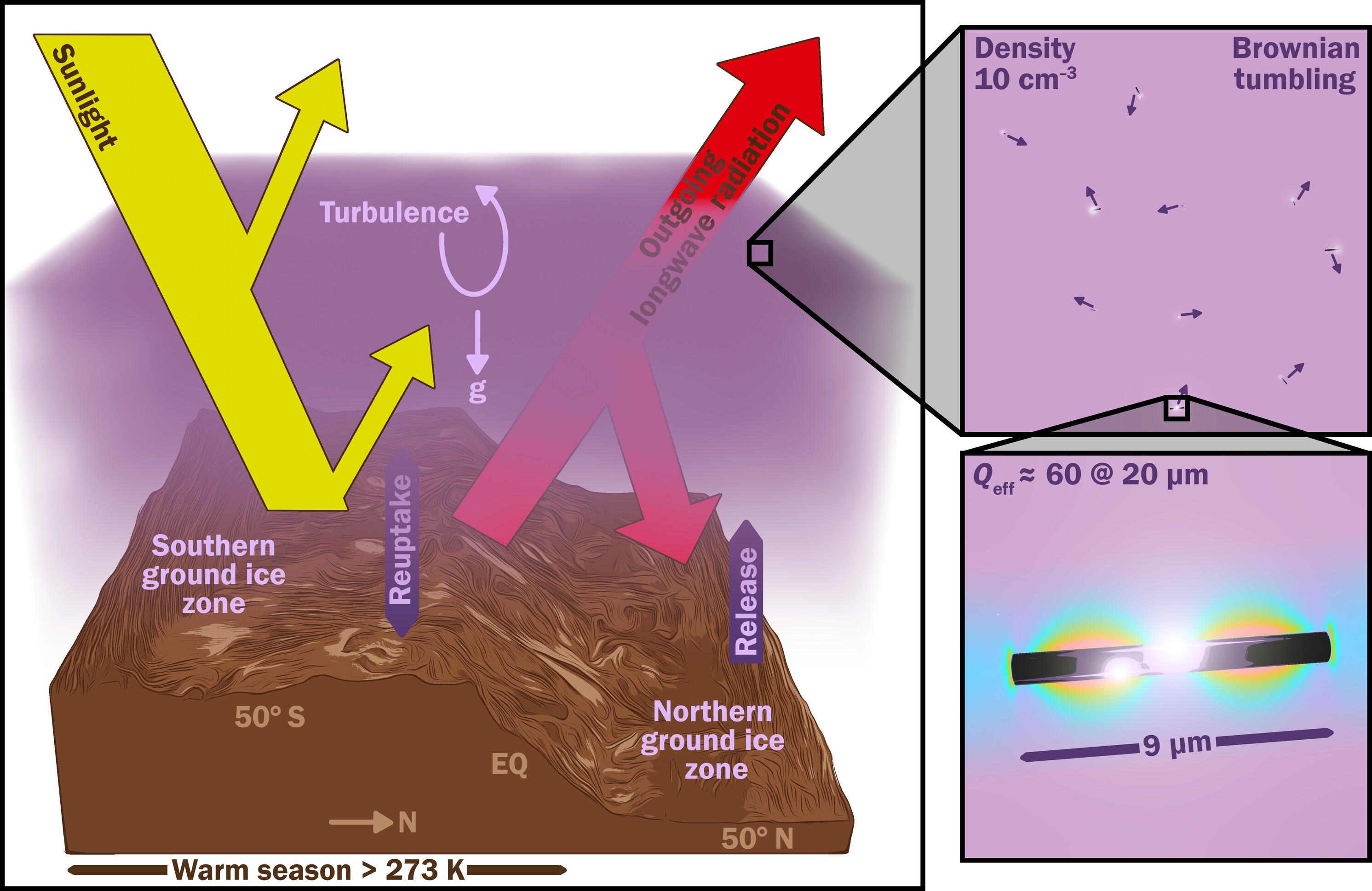
One proposed engineered-aerosol warming method. From Ansari et al. Sci. Adv. 2024. Figure credit: Aaron M. Geller, Northwestern, Center for Interdisciplinary Exploration and Research in Astrophysics + IT-RCDS
Then, in early 2025, Starship demonstrated reusability (and thus, in principle, low cost) for a super-heavy booster whose primary purpose is to reduce the cost for access to the Mars surface by three orders of magnitude.
New possibilities and choices
And with that, a problem that was once science fiction became merely the hardest technological problem that humans have ever faced—something that might be done for the cost of the Apollo program, or the interstate highway system. With the added broad human interest in the future of Mars—most people on Earth have contributed financially to Mars missions, which have been launched by the U.S., China, Europe, India, Japan, Russia, and the United Arab Emirates—possible futures of Mars matter to everyone.
Many questions have to be answered to move terraforming from a purely theoretical problem to something humans might actually do. These include:
How many negative results from Mars probes constitute sufficient evidence that there is no life on Mars already? A few more? A dozen? A hundred? Most people’s answers would fall somewhere in this range, but this will depend on those probes’ capabilities, destinations, and instruments.
If we enable liquid water on Mars by changing the environment, the soil chemistry and environment will still be unfriendly by Earth standards. Could Earth life be adapted to this unfamiliar environment?
How can humanity’s existing framework for the exploration and use of the planets “for the benefit of all peoples, irrespective of the degree of their economic or scientific development”—to quote the Outer Space Treaty—be applied or adapted to sustainable habitats and ecosystems beyond Earth?
If we warm Mars, would it actually create a habitable climate? Climate is more than just temperature.
What warming agent would be used and how would it be emplaced?
Can we actually build and sustain this warming?
Some of these questions are technical, some are societal, and all are important. Through a residency at Astera, we are working to answer the last three questions—the pre-biological questions—with a focus on the engineered aerosol option.6 These map onto our research priorities and deliverables:
A technical roadmap detailing pathways to warm Mars and critical decision points for development of Mars-warming technology over the next five years, including concept design for a precursor/test mission.
Downselect to a single particle design, and share production protocols.
Optimized particle designs, with batch-scale experiments to allow broader testing and validation.
Deployment technology and dynamics.
Detailed analyses of water cycle feedbacks on a terraformed Mars.
This is early stage research and much could go wrong. Perhaps the warming will destabilize. Perhaps the particles will stick together and not disperse into the atmosphere. We’ll find out through prototyping and simulation work, and continue to post about our discoveries. We will keep track of our progress by calculating the implications for the following full-deployment figures of merit:
Power needs on Mars for steady state ≥30K warming
Mass delivered to Mars’ surface per month to emplace system, assuming emplacement over 20 years
$/°C/yr for warming, averaged over 50 years, including any subsystem swap-outs needed.
Calculating these figures of merit will inevitably involve some guesswork, particularly for the financial cost, but we aim to concentrate our energies on possible approaches that could work best at full-deployment scale.
Community
Mars belongs to everyone,7 and we will share our results with everyone, including on this Substack. One of our first shareables is our TerraScreen warming-particle screening tool, which is open sourced at https://github.com/mars-terraforming-research/TerraScreen; our next post will include technical details including results obtained from this tool. We will also create the scaffolding for a broader research community; our first step here will include sharing a framework for model intercomparison (akin to the existing Climates Using Interactive Suites of Intercomparisons Nested for Exoplanet Studies, CUISINES), with all outputs for a single climate model, and sharing all aerosol designs and their radiative parameters.
We need a much larger community to research sustainable habitats and ecosystems beyond Earth (the new field of “applied astrobiology.”) We are already working with Pioneer Research Labs,8 Northwestern University, Aeolis Research, JPL, the University of Central Florida, MIT Haystack Observatory, UCLA, and the University of Chicago Climate Systems Engineering Initiative, among other institutions. Other teams are working on other aspects of the problem, and we are looking forward to the next in the series of Green Mars workshops, which will bring many of us together in Berkeley this September.
Physics, chemistry, ecology, climate science, and planetary systems science constrain the possible futures of Mars. Building up the oxygen level with foreseeable tools will take at least centuries. While low oxygen is not a problem for simple forms of life, it profoundly constrains what humans can do, and how they will live, on Mars. We do not yet have a science of world-scale ecological succession, and it is hard to imagine how such a science could fruitfully develop without experiments. Although climate models are essential tools in assessing the effects of warming Mars, we should not trust them fully: any warming effort will require precursor missions and small-scale experiments to test the models.
An important point is that contemplating people moving into the Solar System is not an escape from Earth’s problems: most of our problems are ones we carry with us. Choosing to terraform Mars is also not a given; if we decide that three billion years as a desert is not enough for Mars, we could of course choose to leave Mars as a desert for another four billion years. (After that, the growing Sun will take the matter out of our hands and melt Mars’s ice caps).
Finally, because Mars is fundamentally different from Earth, we cannot imagine what Mars could eventually become if it is allowed to grow into a green world. It would be like fish crawling on land and imagining what the then-barren continents would become. How could a sea-dweller imagine the evolution of butterflies and flowers?

Edwin Kite
Thanks to Ramya Mahalingam, Alex Kling, and Adrian Dumitrescu for reading a draft of this.
https://arxiv.org/abs/2507.00933
Tegmark, M., 2015. Our mathematical universe. Vintage; also arXiv:1609.05931.
https://ntrs.nasa.gov/citations/19770005775
https://t.co/A90zCQiYeY . The mood is caught by an old story from before the Space Age (1941): Isaac Asimov’s “Not Final!” In the story, a species that is trapped on a high-gravity planet needs force-field technology to move up and out, but it is proven theoretically that any force-field will explode ("That's final! That's final!"). Scientists give up and move on, but an engineer (unaware that what he is doing is supposedly theoretically impossible) figures out by trial and error that rapidly cycling the force-field on and off will make it work without exploding—allowing the species to move out into the Universe.
Ansari, Kite, Ramirez, Steele, and Mohseni, 2024 ( http://arxiv.org/abs/2409.03925 ); and Richardson, Ansari, Fan, Ramirez, Mohseni, Mischna, Hecht, Steele, Sharipov, and Kite, 2025 ( https://arxiv.org/abs/2504.01455 ).
We don’t know if this is the best option for warming Mars, but it is unexplored and appears promising, and we only have the resources to do a deep dive on a single option. We hope that a technically deep ‘existence proof’ for a single option will entice other researchers to build on our work and also stimulate funding for parallel approaches.
Outer Space Treaty: “The exploration and use of outer space, including the moon and other celestial bodies, [...] shall be the province of all mankind.”
https://www.pioneer-labs.org/